Cranes are remarkable modern innovations that enable smooth lifting and handling of a wide range of materials anywhere from manufacturing facilities, warehouses and logistics centres, construction sites, shipyards and automotive workshops, maintenance & equipment repair facilities and steel, oil & heavy industrial plants. Handling fragile materials with cranes doesn’t just mean loading them in a safe manner, but taking apt preventive measures to prevent shock, sway, crushing and sudden load shifts during the operation. A correct safety procedure before using mobile cranes to handle fragile materials would include using the ideal attachment that supports the material, thorough inspection of the rigging before use, moving the load slowly and keeping the path controlled and clear. Major Occupational Safety and Health Administrations keep stressing on induction training for the workers, pre-use checks and safe carrying/transporting practices for loads.
Safety Guidelines for Handling Fragile Materials Using Cranes
Choosing the Right Lifting Device
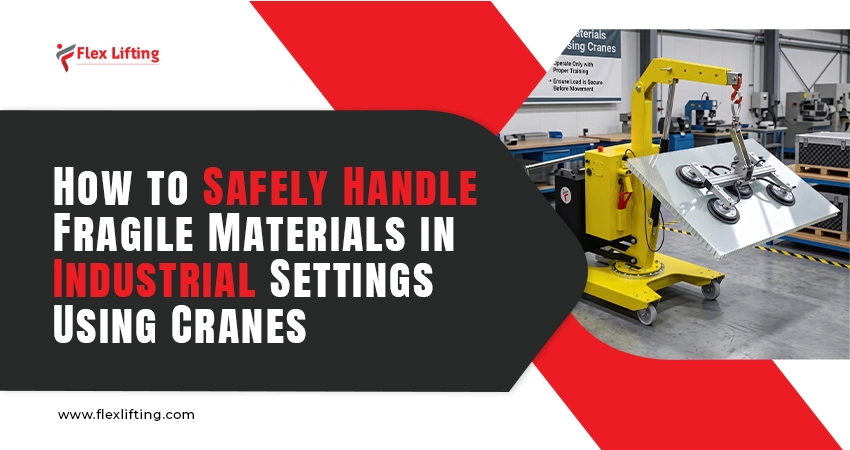
Fragile loads are not the same as ordinary steel stock or pallets. To effectively handle such material, it must be made sure that recommended attachments are used instead of point-loading or crushing it. Some examples include vacuum lifters, spreader beams, padded clamps, soft slings or custom below-hook devices.
Load Awareness: Knowing its Vulnerabilities
Knowing what the load is and what its vulnerabilities are can help in handling it smoothly. Before loading fragile loads up, one has to confirm the weight, center of gravity, dimensions and weakest points. Overlooking these in hope that the crane alone is able while loading fragile materials like glass, stones, finished panels, ceramics and precision assemblies will result in workplace incidents and sometimes injuries. Having a clear idea about these will help in effortless and efficient loading and never testing cranes beyond their rated capacity.
Inspecting Attachments Before Use
Before loading up each and every load, pre-operational crane checks to ensure that the crane can withstand it is needed. Anything from a worn sling edge, damaged hook latch or poor wire rope condition can disrupt the smooth loading and may sometimes even result in a shock-loaded lift in which the integrity of the structural support of the lift can be compromised.
No Sudden Movements
Apart from exceeding the weight limit, uneven motion can also cause damage to fragile materials. In those situations, lifting the load straight up, traveling smoothly and lowering slowly and gently will be the advisable plan of action. Since overhead loads have a tendency to swing as pendulums do, uneven movements from the bridge, trolley or hoist can result in the load cracking, chipping or even getting entirely destabilized.
Always Keep the Load as Low as Possible
Always be aware of keeping the height at a minimum when the load is cleared of obstacles, as lower travel height keeps the swing rate at a minimum and minimizes overall impact risk. In the event of an unforeseen interruption or an accident, lower height offers better control over the load.
Using Tag Lines for Better Control
Tag lines are when a rope is attached to a load to have an external control over it, usually by a worker. Tag lines are an effective go-to solution for large, awkward or wind sensitive fragile loads and they ensure proper rotation and swing. These useful equipment are especially useful for sheet goods, panels and long delicate assemblies.
Awareness of Route and Landing area
Before the load is in the air, it must be seen whether the destination is stable and ready to correctly land it without damaging the load. Any concerning obstruction should be cleared and clearances should be timely confirmed to make sure that there is even support for the load to settle down.
Conclusion
Fragile materials and cranes often requires utmost precision, control and a proper lifting set up.Handling fragile loads safely and reducing workplace incidents–all these go hand-in-hand according to how well & proper the attachments are chosen and the load path is cleared without any potential disruptions.
We offer durable industrial lifting solutions for industry-specific lifting applications and support for safer and efficient material handling operations.
Check out our product wide range and get in touch with Flex Lifting to find the right choice for your industrial requirements